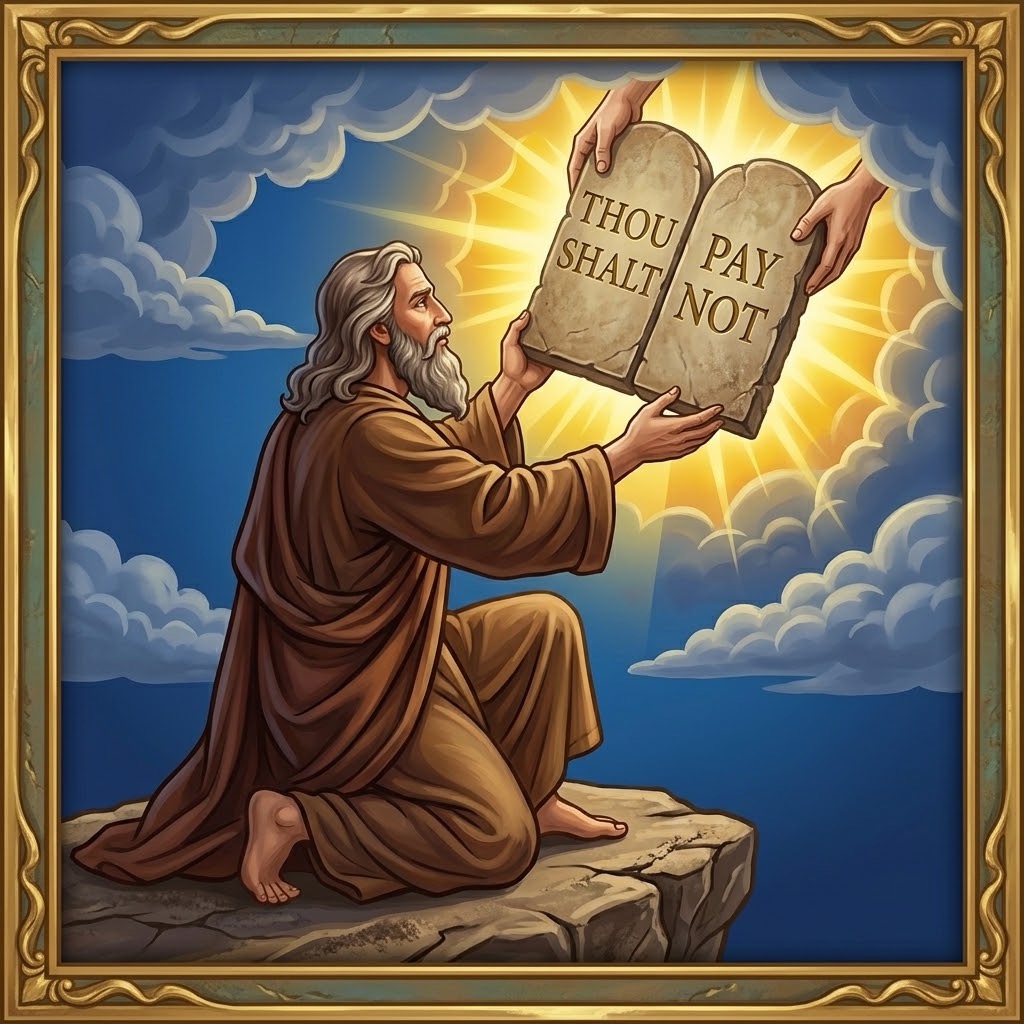
 Thou Shalt Park
 The courtesy that's advertised, then buried.
Ask a big hospital and it will tell you it takes care of visiting clergy. Look for the actual process and you'll often find nothing — or a rule engineered so it can't be used when it's needed. These aren't accidents. They're patterns, and the bill was written to name every one of them.
There is no villain twirling a mustache here. Hospital parking is run by contractors and revenue targets, spiritual care is run by a small overworked office, and the two rarely coordinate. The result, though, lands the same way every time: the person answering a sacred call at the worst moment of a family's life is the one made to pay and made to jump through hoops.
While building the Massachusetts directory, we read the public parking and spiritual-care pages of nine hospitals and called the offices behind them. A few publish a real, usable policy. Most publish nothing. And a striking number had a policy page that has since been removed or redirected — the only surviving copy lives in the Internet Archive. Below are the recurring tactics we saw, why each one defeats clergy specifically, and the exact clause of the bill that shuts it down.
Publicize a "clergy courtesy," post no process
The website mentions that clergy are welcome and parking may be discounted — but never says the step. No sign at the garage, no line at the cashier, no page that tells you what to do. It reads as generous and functions as a dead end.
Route validation through an office that's dark at night
Clergy are called for emergencies — codes, deaths, last rites — overwhelmingly at night and on weekends. When the only way to get parking waived runs through a spiritual-care office staffed 9-to-5 on weekdays, the courtesy evaporates at exactly the hours it's needed most.
Make them leave the visit to get a stamp
Validation is only granted at a desk in another wing or building — so a chaplain has to break away from a dying patient or a grieving family, cross the campus, find the right office, and come back. The cost isn't just money; it's the interruption of the care itself.
Automated pay stations with no one to say yes
After hours, the exit is a machine that takes a credit card and nothing else. There's no attendant with the authority to waive the fee, and the office that could is closed. The technology quietly becomes the obstruction.
Require paperwork filed in advance
"Just have your clergy pre-register with our office and we'll add them to a list." Fine in theory — useless for the visiting priest a family called twenty minutes ago, or the out-of-town rabbi who has never set foot in that hospital and never will again.
Demand ID they can't produce at the booth
Some sites will only honor the courtesy for someone in full clerical attire, or holding a specific hospital-issued badge — so a deacon in street clothes, or an imam or lay minister whose tradition has no laminated card, is turned away at the gate. The proof requirement becomes the denial.
Take the policy page down
Of the hospitals we checked, several once posted a clergy or visitor parking policy that has since been removed or redirected. When we needed to cite the rule, the only proof it ever existed was a snapshot in the Internet Archive. A policy you can't find — and can't hold them to — isn't a policy.
No rule — just a fresh negotiation every time
Instead of a policy, there's a posture: "call ahead and we'll see what we can do." That makes every single visit depend on who happens to be working, how busy they are, and whether they've heard of the courtesy at all. Predictability is the whole point of a law; discretion is how a courtesy dies quietly.
Why a catch-all clause matters
The specific tricks will keep changing — a new gate vendor, a new app, a new form. So the bill doesn't only ban today's tactics; it bans the category. A hospital may not adopt "any policy, practice, fee structure, staffing pattern, or physical arrangement designed or reasonably likely to discourage, obstruct, or frustrate" clergy from parking free. That single sentence — §51K(d) — is aimed squarely at the next clever workaround, whatever it turns out to be.
Access is protected. Affordability isn't.
Federal and state rules already guarantee a patient the right to spiritual care — hospitals have to let a patient's clergy in. What no law addresses is the cost of getting there and back. That gap is the entire problem: the visit is protected, the parking that makes the visit possible is not, and hospitals are free to charge for it or bury the exception. Closing that one gap is all this bill does.
Sourcing: the patterns above are drawn from the public parking and spiritual-care pages of the nine hospitals in the Massachusetts directory and from calls to those offices, compiled September 2026. Each hospital card links to its own source, including Internet Archive snapshots where a page has since been removed or redirected. The clause references (§51K(a)–(f)) are to the proposed Massachusetts bill. This page describes recurring practices across hospital parking systems, not findings of intent by any named institution.