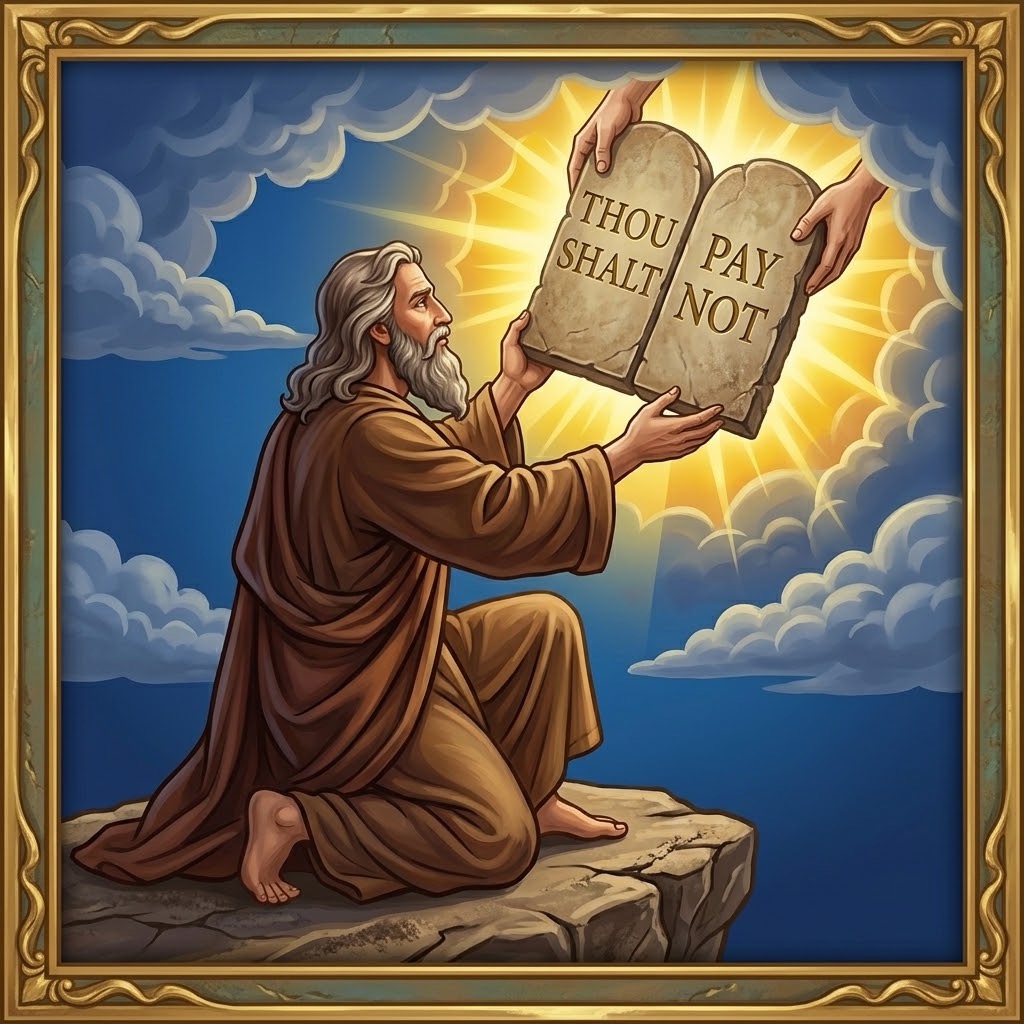
 Thou Shalt Park
 One page of law that closes the gap.
An Act relative to parking access for clergy providing pastoral care to hospital patients. It adds a single new section — §51K — to the Massachusetts public-health statute. Here it is in plain English, with the actual legal text beside each part so you can see exactly what it says.
The whole idea in one sentence
If a hospital charges for parking, it can't charge clergy of any faith who are there to give pastoral care to a patient — and it has to make that free parking genuinely easy to get, at any hour, right at the exit.
Who and what it covers
Plain English. It applies to any licensed Massachusetts hospital that charges for parking. "Pastoral care" is defined broadly — prayer, counsel, sacraments, last rites and comparable end-of-life or emergency observances — for the patient or the patient's family. "Visiting clergy" means an ordained, commissioned, or comparably authorized religious leader of any tradition: priests, ministers, pastors, deacons, rabbis, cantors, imams, and others.
Proof of clergy status — kept simple on purpose
Plain English. Any one of three things is enough: a clergy ID; an ordination/commissioning letter or its equivalent in your tradition (the bill names semichah for rabbis explicitly); or a letter from a congregation or religious body. The hospital must read this "broadly and inclusively," can't demand anything more, can't require you to register in advance, and can't favor or disfavor any religion. This is the clause that stops the "you're not the right kind of clergy" denial at the booth.
The core requirement: free, not "discounted at our discretion"
Plain English. The hospital "shall not charge, and shall validate or waive in full" the cost of parking for a clergy member for the length of a pastoral visit. It's a requirement, not a favor — which is the whole difference between a law and a courtesy.
Available and un-obstructed — the anti-runaround clause
Plain English. This is the heart of the bill. The free parking must be (1) available at all hours the hospital admits patients or allows visitors — nights, weekends, holidays; (2) obtainable right at the exit, at a booth, cashier, security desk, or even the automated pay machine — no separate office, no pre-registration, no interrupting the visit; and (3) provided without undue delay. And the catch-all: a hospital can't adopt any policy, fee structure, staffing pattern, or physical arrangement "designed or reasonably likely to discourage, obstruct, or frustrate" clergy from parking free. See The Problem for the specific tactics this is written to defeat.
Tell people it exists
Plain English. The hospital has to post the process clearly on its website and at every parking facility, and when someone identifies as visiting clergy, staff must tell them the process and that they owe nothing. A right nobody can find isn't much of a right.
Enforcement with teeth
Plain English. The Department of Public Health enforces it as a condition of the hospital's license. It can investigate complaints, fine up to $500 per violation, and treat a pattern of violations as grounds for action against the license — which is the leverage that makes hospitals actually comply.
When it starts
Plain English. The draft proposes an effective date of January 1, 2027. The exact section number, effective date, and penalty amount are the petitioner's suggestions — the Legislature's counsel finalizes those details.
Written to be fair — and to hold up in court
A law that helps clergy has to clear one obvious question: does it improperly favor religion? The bill is engineered so the answer is no.
It's about the patient, not the clergy
The benefit is tied to caring for a hospitalized patient — a patient's access to spiritual support, which is already a protected right — not to any personal convenience for the clergy member. That framing keeps it grounded in patient care rather than religious preference.
Every faith, treated identically
It applies equally to clergy of every tradition and forbids the hospital from favoring or disfavoring any religion. Equal treatment across all faiths is what keeps it clear of Establishment Clause problems.
Verification is loose by design
Requiring a single narrow credential would exclude whole traditions and invite fights over who counts. Accepting an ID or an ordination letter or a congregation letter, construed broadly, includes everyone from a Catholic priest to an imam to a lay minister.
It leans on existing law
It amends the public-health chapter and rides on the hospital-licensing system the state already runs, and it complements — rather than duplicates — the patient spiritual-care access already required by state regs and the federal Conditions of Participation.
What it does not do
It's not a general free-parking law. It doesn't cover a clergy member's own medical appointments or personal errands — only visiting a patient to provide pastoral care.
Downloads
These files are hosted alongside the site. If a link 404s, the document may not be uploaded to the server yet — see the redeploy note in the project handoff. Building the bill for another state? Start from the adaptable model bill.
Want this to be law where you live?
The same one-page bill works in any state. The playbook walks you through filing it — even if you've never done anything like this.
Open the state-by-state playbook